Overthinking on a walk in Germany
Recently, I had the privilege of spending Christmas with my dear friends, the Bulls, in Dresden, Germany. Or perhaps I should say Saxony. There is a great deal of local pride in all things Saxon. The flag of Saxony flies alongside the European and German flags in front of the city’s hotels. Sometimes it feels like pride in the Saxon identity is a substitute for national pride, which is still largely in vogue in the third world but a bit déclassé in the first, and positively frowned upon in Germany.
Any amount of local pride the Saxons of Dresden do have, however, is not misplaced. The city is stunning and lacks any real sign of the decrepitude which has crept into many of the great cities of the West. Rough sleepers, the violently inebriated, and dodgy cell phone stores are largely absent. There is graffiti but it is clearly the work of angsty local teens rather than organised criminal gangs: ‘ACAB’ and the anarchy symbol hastily spray-painted on the pavement running between the cozy Schillergarten and the gentle Elbe are quaint and almost endearing when compared to the crunch of hypodermic needles underfoot in San Francisco.
One of my abiding memories of the city is of two murals which I saw while walking around the city with a friend. The first is the one most famously associated with Dresden: the ‘Fürstenzug’, or the procession of princes, completed in 1876. The mural depicts, from left to right, all the Kings of Saxony from the Margrave Conrad of the 11th Century to King George, Saxony’s penultimate King, who ruled in the late 19th and early 20th Centuries. Moving from one end to the other, I couldn’t take my eyes off the rich detail of this tapestry. The Kings are all depicted mounted on their steeds. One sees the gradual change in dress, from the highly functional tunics, tights, and hunting caps of the high Middle Ages to the flowing robes of the Renaissance, almost out of a Holbein painting, to the consciously Prussian-inspired martial uniforms of the 19th Century. The aristocrats survey the mural imperiously from their mounts, while their knaves, courtiers, and soldiers are depicted as part of the procession on foot.

Even as a complete outsider to the tradition it represents, it was a striking scene of continuity, permanence, and grace. The fact that it was thought appropriate to emblazon this mural where it can’t be missed means all involved were unafraid to express their belief in aristocracy and hierarchy.
That, of course, was 1876. The next seventy-five years would shake the foundations of which the Fürstenzug is essentially a blueprint. The uniformed Princes plunged Europe into a haemoclysm in 1914, a war from which the Empires of Europe would never recover. The best and bravest of Europe, especially and contrary to popular myth, the sons of the ruling classes, were mowed down. In the decade following the Great War, twenty-nine thousand country estates in Britain alone were auctioned off in fire sales for want of heirs. In 1917, the Bolshevik Revolution in Russia plunged the continent into what Nolte calls ‘the European Civil War,’ a war in which the Communists would triumph over half of Europe in 1945, while the Americans would assume trusteeship of the other half.
This brings us to the next mural, put up almost a century after the Fürstenzug, in 1969. This isn’t as famous as its more conservative counterpart – for very good artistic reasons – but to me, it was equally striking. It adorns the side of the Kulturpalast, the ‘palace of culture,’ an unremarkable but clean modernist block which nonetheless sticks out like a sore thumb in the baroque city centre.
It is interesting for a number of reasons, not least its location a few hundred steps from the Fürstenzug (not, I think, a coincidence.) For one, the way in which the painting approaches the viewer is very different. Every figure in the Fürstenzug is seen in profile. You approach it as a member of an audience to the regal procession. You are in awe of the figures in the portrait who in turn are largely unconcerned about you but gazing intently at their predecessors, each Prince perhaps assessing his place in this lineage. In ‘The Way of the Red Flag,’ on the other hand, every figure is staring directly at you. One or two seem busy with their family or helping old people, but for the most part, even the people standing in groups are looking not at each other but at you. The hero is clearly the anonymous, muscular, and slightly annoyed East German lady in the centre. At the time, I’m sure it could reasonably have been seen as an inspiring exhortation to collective effort. When the Kulturpalast went up in 1969, the country wasn’t doing too badly. While still far behind the West, they had managed to build the Warsaw Pact’s most productive economy, and even outstrip the FRG in the provision of certain consumer goods, particularly refrigerators (I cannot recommend Katja Hoyer’s ‘Beyond the Wall,’ which I got as a Christmas present, highly enough. It’s very engaging, and I finished it by New Year’s.)
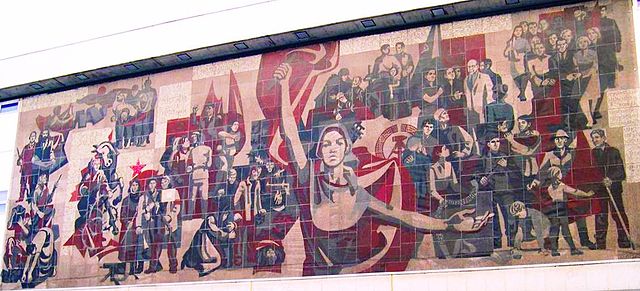
As I looked up at the mural, however, I also sensed a certain cruelty in it, a brutality in how it seeks to efface any sense of particularity and place: there is nothing distinctly Saxon or German about it. If not for the state emblem of the GDR lurking in the centre, it might have been anywhere in the Eastern bloc. Even the features of the human faces in the mural are highly formalised. The artists, I think, were rather reluctant to concede that even the superhuman Stakhanovite of the future would have to have two eyes, two ears, a nose, and a mouth. There are no mounted aristocrats here, though the professional middle classes do find a place (the East Germans were kinder on them than other socialist states: the coat of arms on the flag of the GDR includes not just stalks of wheat and a hammer for agricultural and factory workers, but also a compass for the middle classes). The largest and most important figure is the woman exhorting you to action. Everybody else is the same size – the doctor in his lab coat, the coal miner, the soldier. The men in suits are tucked away at the back; the foreground is dominated by the appropriately proletarian, in what I think was a clear message about the new order of things.
Art, of course, reflected life in this respect. While the middle classes were made to cede their privileged position in education, government, and sport, those further up in the old hierarchy often paid a heavier price. Hoyer writes of the fate of Joachim Ernst, the last Duke of Anhalt:
“His anti-fascist record was good. The forty-four-year-old had been a vocal opponent of Nazi rule and spent three months in Dachau concentartion camp in the winter of 1944. He welcomed the liberation from Nazi tyranny. His heart sank when he noticed that the Russians wore blue trousers and caps with a cornflower blue top and maroon band underneath … They were NKVD Officers. They arrested the Duke without charge and dragged him to the ‘Red Ox’ in Halle, an infamous prison … The Duke of Anhalt was eventually transferred to NKVD Special Camp 2 at Buchenwald where he began to starve and eventually contracted hunger typhus. He died there at the age of forty-six.”
It is hardly surprising that an ideology totally convinced of its place in the historical dialectic is harsh on the past. The path of Marxist history seldom admits detours and rambles along pleasant country lanes. Historic Dresden was fully rebuilt from its wartime destruction only after the reunification of Germany. Had that event not occurred, perhaps more of the city centre would look like the Kulturpalast and it would be the Fürstenzug gathering dust with visitors scorning the values it represents. My friend informed me that there have been calls to tear down the Kulturpalast and the mural along with it. I hope these do not gather steam: I enjoy anachronistic curiosities, and ‘The Way of the Red Flag’ seems far, far older than the Fürstenzug.
 The Department of Things in General
Leave a comment